At Drive to Zero 2026, EVBox will unveil its Decentralized Distributed Architecture (DDA), a new approach to fast charging designed to address the economic and energy-related challenges of electric mobility.
As the demand for high-power charging continues to grow, many sites remain constrained by their electrical grid connection capacity, where every increase in available power can generate significant costs and long lead times for operators. In this context, oversizing infrastructure in order to deliver the desired power at a charging point becomes both costly and inefficient.
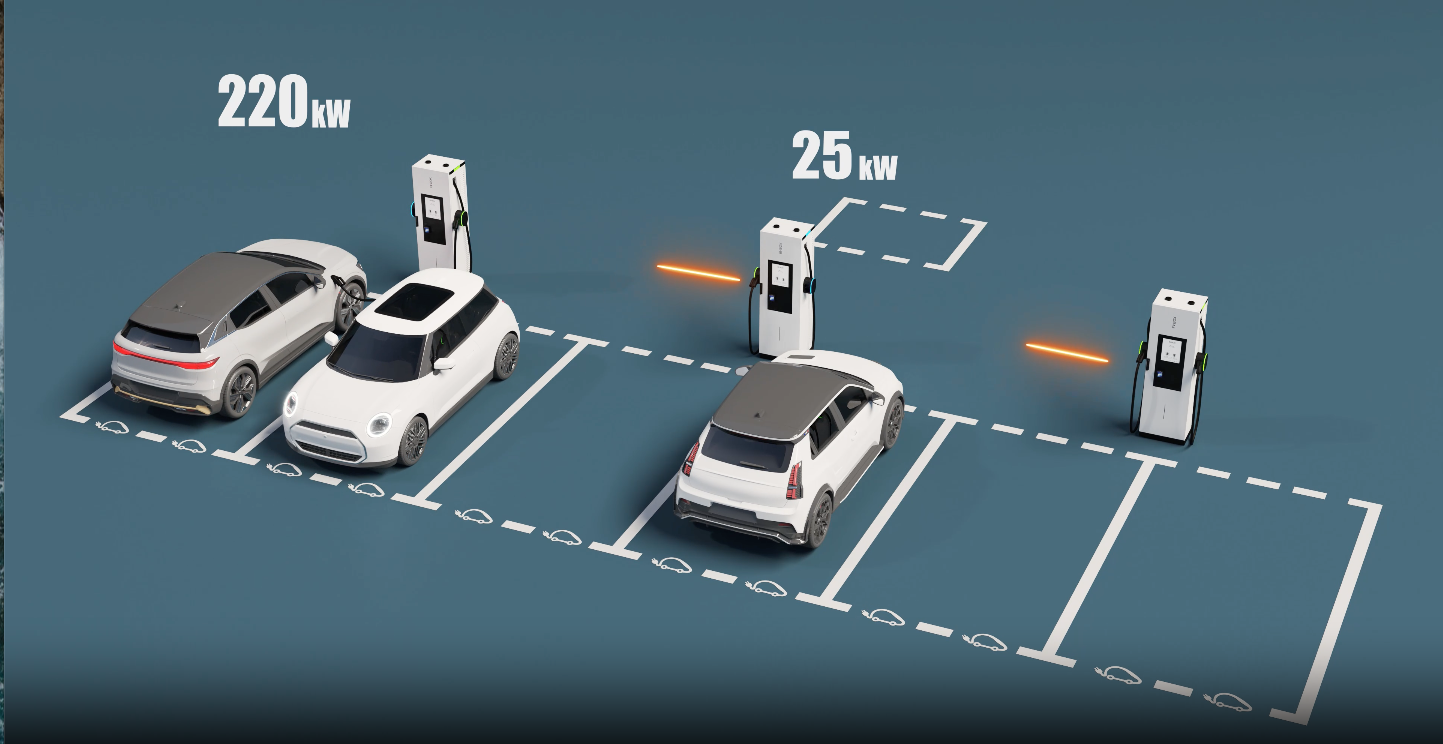
Thanks to dynamic power distribution between charging points, the DDA optimizes the use of the energy available on-site without multiplying oversized equipment. The architecture delivers full power when needed while limiting infrastructure costs and constraints related to the electrical grid connection.
The result: a more flexible, more profitable, and better market-adapted charging infrastructure.
A new generation of fast-charging infrastructure
Charging needs are evolving rapidly. Between long-distance travel and the growing adoption of professional fleets, operators require infrastructure that is smarter, more flexible, and more profitable.
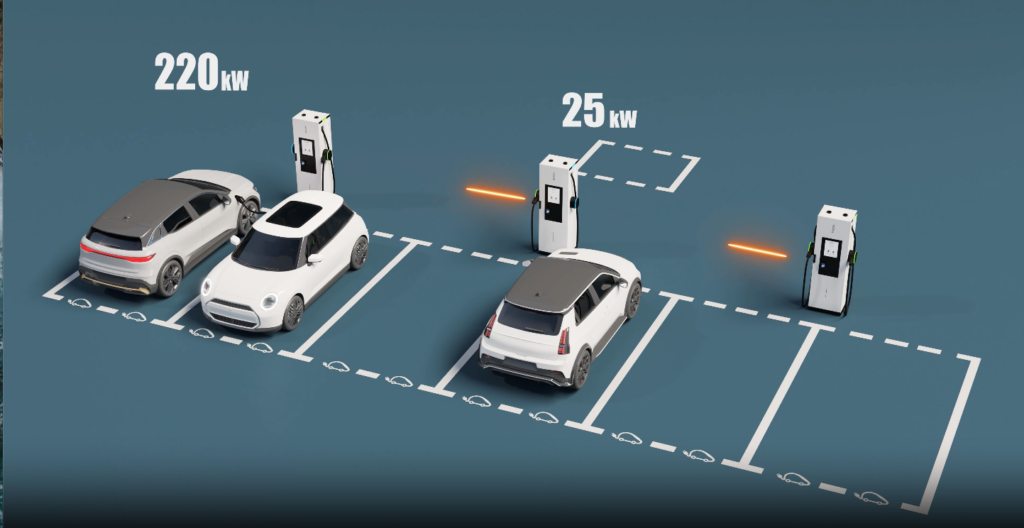
With the DDA, EVBox adopts a different approach to fast charging. Power is dynamically distributed across the entire station in order to optimize the use of the electrical connection and adapt charging to the real needs of connected vehicles.
This architecture avoids infrastructure oversizing, reduces capital expenditure (CAPEX), and improves site profitability, while ensuring a high-performance and scalable charging experience.
An architecture designed for the networks of tomorrow
One of the main challenges operators face today is the ability to scale their stations over the next decade without having to completely rebuild existing infrastructure.
The Decentralized Distributed Architecture directly addresses this challenge through a modular and scalable design.
Sites can be gradually expanded in line with growing demand, with simplified integration of new charging points or additional energy capacity on existing charging points.
This flexibility allows operators to:
- better control their investments;
- support evolving usage patterns;
- improve charger availability;
- prepare for future generations of electric vehicles.
A response to availability and performance challenges
In the fast-charging industry, reliability has become just as important as power output.
The DDA architecture reduces dependency on a centralized power conversion unit and improves service continuity by distributing resources across the entire site.
This distributed logic helps strengthen the overall resilience of charging stations and limits the impact of potential maintenance operations. A charger undergoing maintenance can be electrically isolated from the rest of the station.
For drivers, this translates into a more stable charging experience and better infrastructure availability.
EVBox at the heart of discussions on the future of charging
Drive to Zero is a major event for stakeholders committed to the decarbonization of mobility and the development of electrical infrastructure.
Through the presentation of our Decentralized Distributed Architecture, we aim to open a new discussion on how tomorrow’s high-power charging networks should be designed.
Beyond technical performance, this approach reflects a broader vision: infrastructure capable of evolving over many years, adapting to real-world usage, and sustainably supporting the transition to electric mobility.
Meet EVBox at Drive to Zero 2026
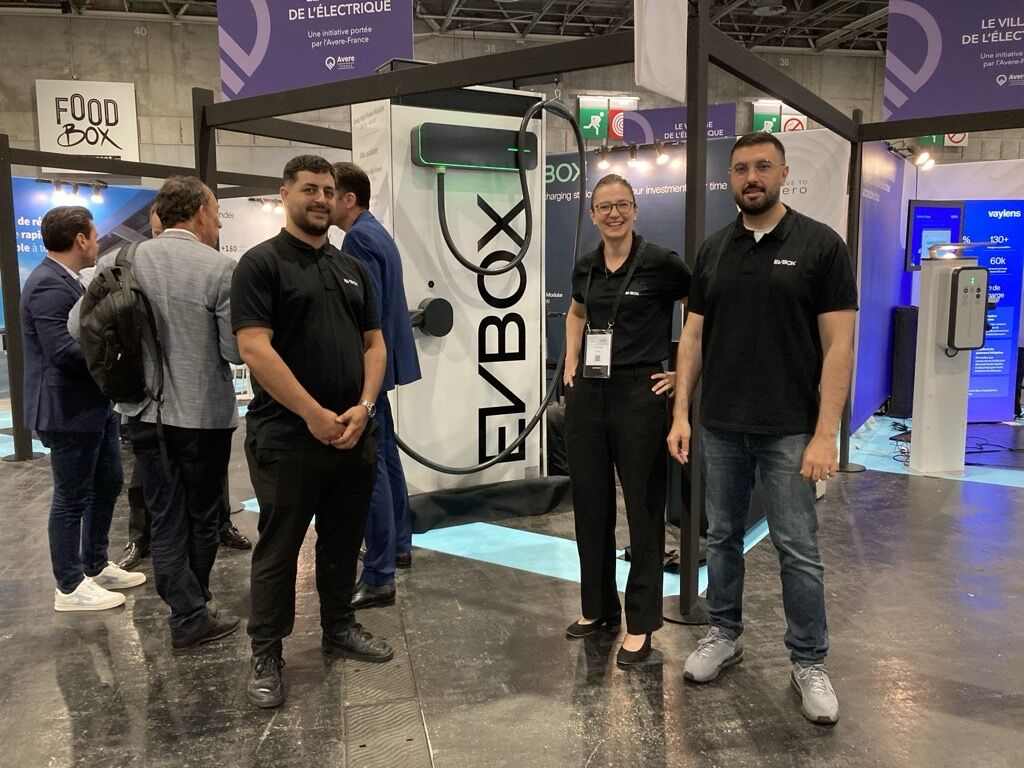
Visitors to the event will be able to explore the principles behind the Decentralized Distributed Architecture in greater detail, as well as our vision for the next generation of fast-charging infrastructure.
📍 Visit EVBox at Drive to Zero 2026 Hall 5.3, Booth C36 to meet our teams and discover the innovations shaping the future of electric charging.
Similar articles

Reading time 5 min
When Climate Expertise and Industrial Innovation Join Forces to Accelerate the Energy Transition
The transition to electric mobility is often viewed through a technological lens: charging station performance, charging power, connectivity, and user experience. Yet another challenge is becoming increasingly unavoidable: ensuring that the infrastructure supporting this transition also meets the environmental standards it is designed to promote. It is…
Continue reading
Reading time 5 min
A New Chapter for Fast Charging
For a long time, high-power charging infrastructure has been built around a simple principle: add more chargers, more power, and more central power cabinets. However, as the number of electric vehicles continues to grow, this approach is gradually reaching its limits. At EVBox, we believe that a high-performance charging…
Continue reading
Reading time 5 min
EVBox and FlowEmo: Making Charging Infrastructure Easier to Understand
The future of charging infrastructure is no longer only about power output or product performance. As the market evolves, other factors are becoming increasingly important: flexibility, scalability, profitability, optimization, and ease of deployment. At EVBox, this transformation is reflected in our continuous efforts to improve charging infrastructure standards,…
Continue reading